
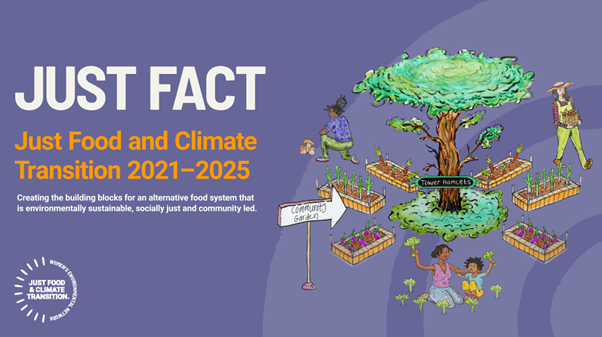
Just FACT was a 5-year multi-partner programme, funded by the National Lottery’s Climate Action Fund. Coordinated by the Women’s Environmental Network (Wen), the programme sought to build an environmentally sustainable and socially just food system in Tower Hamlets by bringing together grassroots organisations, residents, and community groups.
From the programme's inception, Lucy Harbor, CAG Partner, served as the programme evaluator. Lucy was a project partner, and deeply integrated into the programme's lifecycle to ensure a culture of continuous learning throughout the five years.
Responsibilities included:
- Framework development: Collaborating with project partners at the start to co-create an evaluation framework and a Theory of Change.
- Capacity building: Delivering a series of evaluation workshops and learning sessions during quarterly partnership meetings, to offer guidance and support to community groups, many of whom had not done evaluation before.
- Annual process Evaluations: Surveying partners annually to assess what was working well, how the programme aligned with its core values (such as "Communities in the Lead"), and where improvements were needed.
- Sharing learnings at programme quarterly meetings.
- Calculating carbon emissions savings from programme initiatives, using data collected by groups
- Programme evaluation and reporting: Evaluating the impact of the programme by analysing evidence and learnings from the partners’ annual progress reports, and from interviews with the WEN team and partners. Findings were included in annual progress updates to the Climate Action Fund and the final comprehensive evaluation report.
- Inputting into learning briefs on themes from the programme.
Outputs of the Just FACT programme include:
- Lucy’s detailed evaluation report: The Just FACT Evaluation report
- A summary programme report: The final Just FACT report
- A suite of learning briefs
- The Power of Food film
Key Impacts of the Programme
The Just FACT programme successfully demonstrated that food is a powerful entry point for climate engagement. Over five years, the programme delivered the following impacts:
- Measurable carbon savings: The programme achieved an estimated 6.7 tonnes of CO2e savings from projects that collected data. The most significant contribution came from the Plastic Free Markets pilot, which resulted in 364,000 fewer plastic bags being used annually.
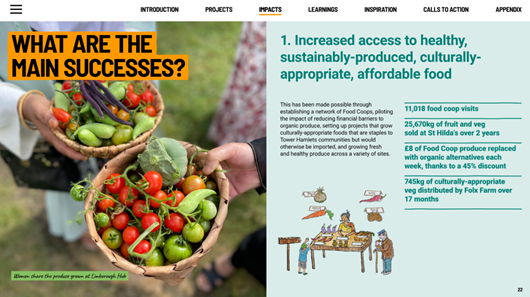
- Improved food access: A network of community-led Food Co-ops was established, which was visited over 11,000 times and distributed more than 25 tonnes of fresh produce. Affordability pilots successfully enabled low-income residents to access organic food by reducing price barriers.
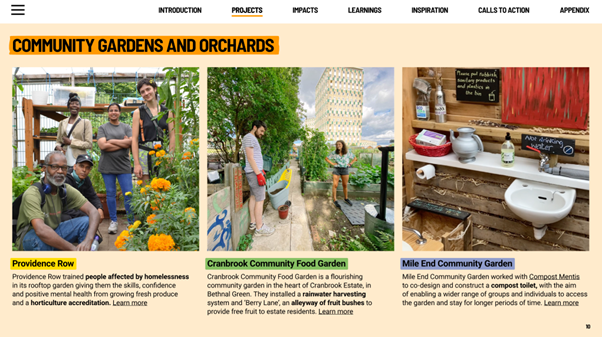
- Community empowerment: The programme funded 26 grassroots projects, engaged over 21,000 participants, and involved 4,500+ volunteers. It also fostered career progression, with volunteers transitioning into paid "green" roles and homeless clients gaining horticulture accreditations.
- Movement building: Just FACT created a robust network of 26 funded projects, widely considered the programme's most enduring legacy. This network successfully influenced local policy, leading to the Tower Hamlets Council signing the Glasgow Food and Climate Declaration.
- Health and wellbeing: 13 projects reported significant improvements in participant wellbeing, citing reduced isolation, improved mental health, and a greater sense of community connection through nature and gardening.
Key Learnings
The evaluation process captured vital insights for future place-based climate action:
- Trust takes time: Inclusive climate action requires long-term investment in relationships and community capacity. Deep participation relies on consistency and trust, which often takes longer than originally anticipated.
- Communities in the lead: Shifting power to local people through participatory grant-making—where community members decided where funding should go—increased the relevance and reach of projects.
- The "everyday" lens: Linking climate change to immediate, everyday concerns like the cost of living, health, and cultural heritage was far more effective than focusing on abstract environmental goals.
- Bureaucratic barriers: Even small-scale sustainable infrastructure projects, such as rainwater harvesting, faced significant delays due to complex local council permissions and a lack of clear processes for non-traditional projects.
- The limits of bottom-up action: While grassroots initiatives are powerful, project leads reflected that systemic transformation ultimately requires transformational policy at the national level; grassroots action alone cannot carry the entire burden of a just transition.
It’s been invaluable to have Lucy’s support with Just FACT programme evaluation; developing comprehensive frameworks and evaluation plans, running engaging workshops and producing detailed reports in a collaborative way. Lucy was very supportive, positive, and flexible - helping us navigate a complex programme with many moving parts. She has been consistently reliable and professional, always delivering work on time and to a high standard. With her support and expertise we were able to gather and analyse a large volume of data, to demonstrate wide-ranging impacts and the exciting potential of the work - we're very grateful for her role, we would not of managed this without her!