
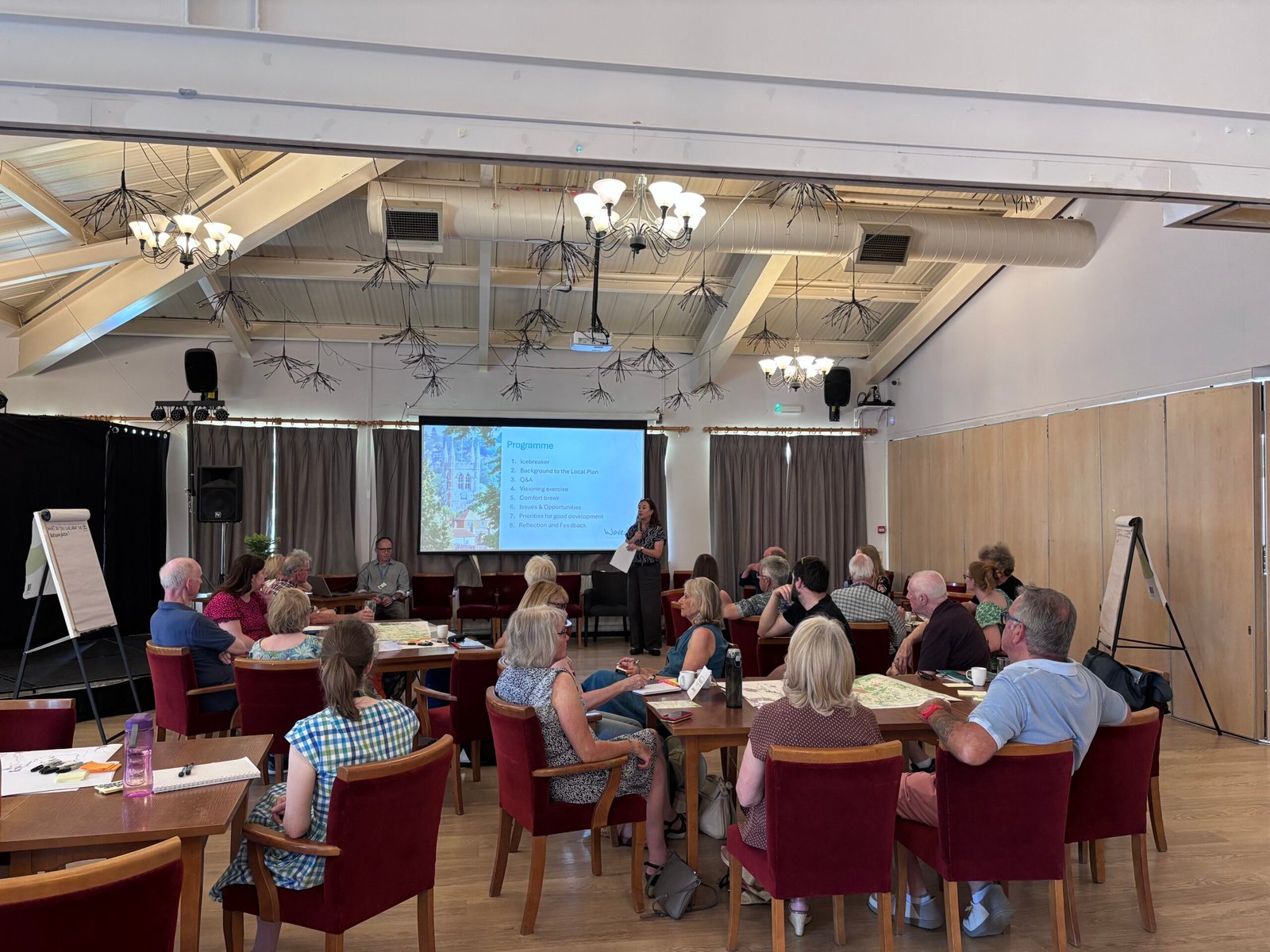
Between 2025 and 2026, Waverley, Guildford and Rushmoor Borough Councils each commissioned CAG to design and facilitate stakeholder engagement to inform their new Local Plans. Across the three boroughs, CAG delivered 11 workshops with councillors, parish and town councils, community organisations, businesses and statutory consultees.
The commissions came during a period of major change in plan-making. A new system came into force in England on 25 March 2026, with a stronger emphasis on early engagement. Councils preparing plans under it are expected to adopt them within 30 months of Gateway 1, the self-assessment that starts the formal process. They must run a scoping consultation before Gateway 1 and two further consultations afterwards, publishing a summary each time of the feedback and how it has been considered.
Our approach
Each of the three councils was at a different stage in the process. CAG therefore designed each programme around what the council needed to learn, who needed to be involved and how the findings would feed into the next stage of plan-making.
- Waverley held its workshops in June 2025, under the previous system. The council wanted early input to its vision, objectives and options for growth. CAG ran four workshops, two online and two in person in different towns, so that views could be compared across the borough.
- Guildford held its workshops in January and February 2026, before its formal process under the new system had started. Four in-person workshops with borough councillors, parish councils and community groups built understanding of how plan-making was changing. They also gathered views on the borough's key issues and its future.
- Rushmoor held its workshops in summer 2026, during its statutory scoping consultation under the new rules. CAG designed three workshops for three audiences: businesses, community groups and statutory consultees. Each complemented the council's online survey.
Although the programmes were different, they were based on the same principles of good engagement. People were involved while there was still scope to influence the plan. Council planners provided enough context for informed discussion, including what was determined by national policy and what could be shaped locally. Activities were designed so that everyone could contribute, not only the most confident voices, and access needs were considered in advance. CAG facilitated every session independently.
Outcomes
In Waverley, 110 people took part across four workshops, and the council received CAG's draft report within a week of the final session. In Guildford, 42 people took part across four workshops. Waverley and Guildford have both published CAG's reports on their Local Plan web pages. In Rushmoor, CAG's feedback note brought together the findings from all three sessions for the council to use alongside its survey responses.
The workshops gave the councils evidence to inform the next stage of plan-making. In Guildford, they showed where consensus existed. Councillors, parishes and community groups reached considerable consensus on priorities including affordable housing, infrastructure, sustainable transport, the town centre and protection of the Green Belt. In Waverley, they identified where the plan would need to reflect local differences. Participants described the workshops as well-organised, engaging and worthwhile. They particularly valued the small-group discussions and the opportunity to be heard.
The value of independent facilitation
Each council chose to bring in an independent facilitator. The three programmes showed how that helps at this stage of plan-making.
- Officers can listen. With CAG running the sessions, planning officers were free to explain the context, answer questions and hear what participants said, without also having to manage the room.
- Everyone gets a fair hearing. An independent facilitator has no stake in the outcome, which helps participants to speak openly. It also keeps the discussion balanced, so that all participants can contribute.
- Councils gain tested methods. CAG brought approaches refined with other councils, and each programme built on the experience of the last.
- Planning teams gain capacity. The new timetable puts pressure on planning teams. CAG designed, ran and wrote up the workshops, allowing officers to concentrate on preparing the plan.
- The findings are independently recorded. Each council received an impartial account of what participants said, which it can publish and draw on when showing how feedback has been considered.
What we learned
Working with three councils at different stages of plan-making highlighted several lessons for future Local Plan engagement.
- Early engagement changes the tone of the conversation. Participants welcomed being involved before decisions were made, and the discussions found considerable common ground. Even on housing, where views differ most, there was shared support for more genuinely affordable homes.
- Clarity about what is fixed makes for a better discussion. Council planners explained what national policy determines and answered questions openly. This allowed the discussion to focus on the choices that are open locally.
- Local differences matter as much as the borough-wide picture. Priorities varied between towns and villages in the same borough. Organising discussion around the places people know allowed those differences to be recorded, not averaged away.
- Different audiences need different formats. Councillors, parish councils, community groups, businesses and statutory bodies bring different knowledge and have different amounts of time. A single format would not have served them equally well.
- Showing how feedback is used builds confidence. Participants are keen to see how their input informs the plan. Waverley and Guildford both published the workshop reports, and the new requirement to publish consultation summaries gives all councils a clear way to show how feedback has been considered.
- Workshops work best as part of a wider programme. They provide depth and dialogue that a survey cannot. Each council combined them with wider public consultation, which reaches a broader range of people.
- Each session improves the next. CAG gathered participant feedback and used it to refine later sessions, for example by simplifying an online tool.
If you would like to talk to CAG about how we can support your organisation with stakeholder engagement, please contact Emma Jones at ej@cagconsult.co.uk or Denny Gray at dg@cagconsult.co.uk.